Thursday, December 4, 2014

How to make Tincture properly


Tincture are concentrated herbal extract dissolved with alcohol where effective substances are alkaloid, tanin,glycosides, flavonoid polyphenolic compound,essential oils and such other natural product
5ml of tincture or single dose has the same effect like a cup of herbal tea and  it's just concentrated is caused to make easy absorbent in to body by alchol or other solvent
High-proof alcohol such as vodka or brandy works well and as an alternative to alcohol; if necessary, high quality apple cider vinegar is used.

what is needed?


  • fresh or dried herbs are selected according to your choice 
  • A pint jar (16oz) with a tight-fitting lid
  • Small, dark glass bottles to store tincture
  • Fine cheesecloth or muslin
  • A bowl 
  • A small funnel


It’s very easy to make your own tinctures; you literally just need to soak plant matter in a solvent(alchol or vinegar) for a six weeks so all of its active compound  can be absorbed into the liquid.vodka is usually the best choice and  it has to be at least 80-proof (namely, 40% alcohol) to prevent any mildewing of the plamnt material in the bottle. 100-proof (50% alcohol) is better.This high-proof alcohol acts as a preservative, and if you store your tinctures in a cool, dark place, they can have a shelf life of 7-10 years.
If you're using fresh herbs which should be chopped up as  bit or bruise them with a motar and pestle. fresh herb should be put in to jar about 3/4 full but don't pack in it too tightly; then plant part is needed to cover with alchole and fill the jar well but be loose enough to more around and part of the plant is not needed to expose air. then closed the lid on tight

Tuesday, December 2, 2014

Ayurvedic Tea


Brewing method 
Two cups water to 1 or 2 tablespoons of dried leaves or flowers. To brew a single cup using 1 teaspoon of dried herbs. Depending on the herb you will generally use hot to boiling water and Pour hot water over the herbs in a closed container and leave to steep. You can use dried herbs 2times or 3times to make herbal brew after1st usage by drying.

Brewing time:
20 minutes is needed to infuse. This herbal tea is not similar to brewing "tea", you know Camellia sinensis becomes bitter and undrinkable when it takes more time to infuse. Most herbal teas are gained by longer steeping time and it’s caused to extract the active compounds. Brewing the herbs in a closed container like an enamel teapot which preserve volatile compounds such as essential oils from evaporation.

use:
herbs should be let to settle in to the bottom and pour off the top while letting the herbs soak in the water. The second cup is often better than the first.You need not throw out the leftovers either, and may want to reuse them as a "starter" for another fresh batch.

Storage:
Unused portion of herbal in a glass jar with a air tied lid and refrigerate. Herbal tea not should be kept longer than 3 days and second day is much better.

Sun  Tea:
put fresh or dried herbs in a glass jar fill  with water and  place in a hot, sunny windowsill for several hours.

Moon Tea:
place  the herb in an open crystal glass. fill the  fresh water until cover herbs  and place directly in the moon light(full moon being the best time) Do not cover. Allow to infuse overnight and drink in to empty stomach in the morning which  work best with fresh, aromatic herbs are much propper.

Monday, December 1, 2014

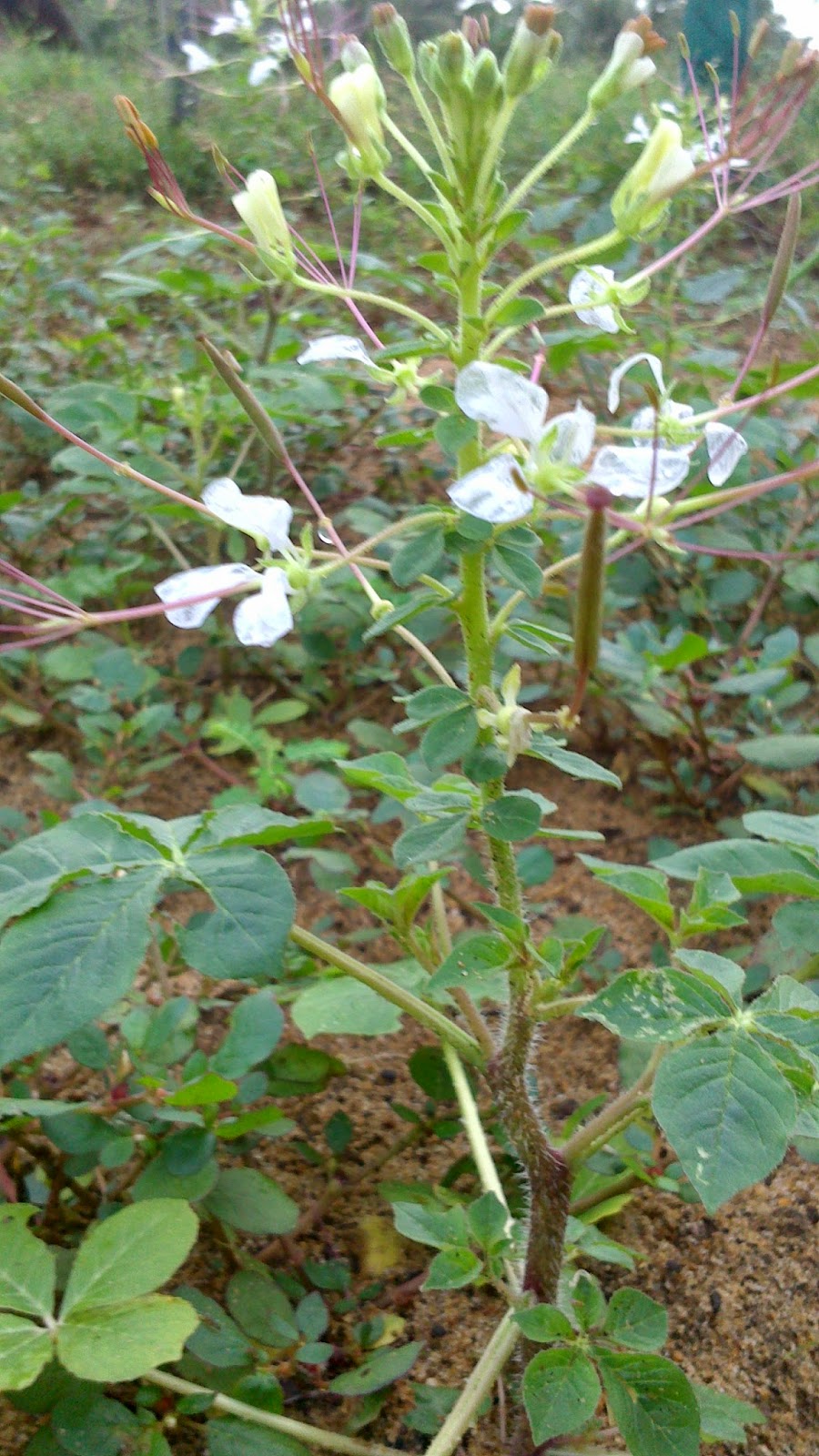
WELA (WILD SPIDER PLANT)

Ayurvedic plant
http://classicaurvedic.blogspot.com/ 

  Cleome gynandra

  Sanskirt name :-  Ajagandha

  Description

Erect annual herb grow up to 1.6m tall strongly branched, with long taproot and few secondary roots; stem densely glandular. Leaves alternate, palmately compound  leaflets are 3 to 7; stipules absent; petiole 2–10 cm long, glandular; leaflets almost sessile, obovate to elliptical or lanceolate, 2–10 cm × 1–4 cm, cuneate at base, rounded to obtuse, acute or acuminate at apex, margins finely toothed, sparsely to distinctly hairy. Inflorescence a terminal raceme up to 30 cm long, bracteate. Flowers bisexual, white or tinged with purple; pedicel 1.5–2.5 cm long; sepals 4, free, ovate to lanceolate, up to 8 mm long; petals 4, elliptical to obovate, up to 1.5 cm long, clawed; androgynophore 1–1.5 cm long; stamens 6, purple; ovary superior, stalked, 2-celled. Fruit a long, narrow, cylindrical capsule up to 12 cm × 1 cm, stalked and beaked, usually green or yellow, dehiscing from below with 2 valves, many-seeded. Seeds subglobose, 1–1.5 mm in diameter, grey to black, irregularly ribbed. Seedling with oblong cotyledons; first leaves 3-foliolate  

Cleome comprises 150–200 species. It is classified in the subfamily Cleomoideae, sometimes considered as a separate family Cleomaceae.Gynandropsis has been merged with Cleome, as the distinguishing character. The spiderplant has a distinct androgynophore with stamens and ovary well beyond the corolla.


Chemical Constituents

This herb are comprised; apegenin,beta - sitosterol, cleogynol, cleomin,glucocapparin,hexcosanal, kaempferol,7 phenoxycoumarin, Lactone - cleome - olide , linolex acid ,myristic acid, oleic acid, palmatic acid, peduletin acid ,viscosin.

As a Medications 

Gastro intestinal disease - A decoction of the leaves or roots is used to tread stomachache and to control constipation 
cough                            - Infusion of seed is used to treat for cough   
analgesic                        - Headaches,neuralgia,rheumatism and other local pain 
others                             -A decoction of the leaves and roots used to uterine complain and easy child birth
                                        it is given during delivery, continuing taking this and during the postpartum period                                      
                                        would help hasten the process of recovery 
                                        The sap of young leave is good for use to treat epileptic-tis and use as a eye 
                                        wash

PRANAJEEVA


     Codariocalyx motorius

     Family             :  Fabaceae
          
     Description  :
     Plant is a shrub and perennial grows in a tropical climate

     Cures for      :
     Cough 
     Haemoptysis
     Rheumatism 
     Diarrhea 
     Hepatisis 
     Wounds
     Dysentery 
     Maleria 

Wednesday, November 26, 2014

Akkapana


kalanchoe laciniata

Local name:Akkapana


Description:

Perennial herb tall is 1m ,glabrous ,Stems stout
Leaves bipinnatifid, very succulent(7.5 - 10) cm long
Inflorescence 12 - 15 cm long
Status is native in Srilanka


Medical Uses:

Abscesses
Boils
Cuts
Diarrhea
Hemorrhoids
Inflammation
Renal Stone
Ulcers
Vomiting

Akkapana

 kalanchoe laciniata

Local name:Akkapana

Description: 
Perennial herb tall is 1m ,glabrous ,Stems stout
Leaves bipinnatifid, very succulent(7.5 - 10) cm long 
Inflorescence 12 - 15 cm long 
Status is native in Srilanka
 

method of decoction

The herbal ingredients of the prescription are washed and dried to constant weight the plant material so prepared is made  into a coarse powder separately by using mortar and pestle. 50g of each of the powdered ingredient are added to five liter of water and this volume is reduce to1\8th the original volume by gentle volume

Proficient Ayurvedic Physician in Ancient Era


king Ravana ( Dasis Ravana)


Ravana  is  a great Scholar inAyurvedic medicine. He was the person who invented “Arka Shastra”," Nadi Prakashaya"," uddisha tantraya","Prakrurtha Kamadhenu".  


The book “Arka Prakshaya”,.which is a method of making tincture is very sophisticated method .as his willing to research in Ayurvedic medicine.


He wrote several books revealing the cures for many diseases. The book “Kumara Tantraya” which elucidate the treatments for infant diseases was written by him accepting the request of his pregnant queen Mandodari

Kumara Thantraya sayed that  Health is 
the condition of the human body that is called free of disease. If oil and wick are present in sufficient quantity, the lamp will maintain burning, otherwise  due to some shortage there may be cause to worry in similar manner, you have to give food for the infant  at the proper time, and meal after regular intervals have lapsed, and unpolluted food, otherwise the mother may suffer from depression and the result is that her breast milk will become inappropriate to consume. By prominant of a stress lifestyle, Mother may (also) suffer from depression.And, by drinking this (polluted ) milk, various forms of ailments may arise in the infant's body. 

Tuesday, February 8, 2011

Paspalum scrobiculatum


Paspalum scrobiculatum Linn. Mant. 1767.

Vernacular name of sinhala : Amu , Karal – Amu.

Perennial grass with stems 60 – 90 cm high, tufted, erect or suberect, rather stout, lesfy from the base upword; leaves bifarious, erect or subrect, 15 – 22.5 cm long, 0.2 – 0.8 cm cm broad, flat, finely acuminate, mid – vein slender, margins : scaberulous; sheath 10 – 20 cm long,compressed, loose, mouth hairy ligule very short, membranous; spikes 2 – 6, sessile, usually distant and spreading,2.5 – 15 cm long,rhachis filiform or broad and concave,margins ciliolate; spikelets closely imbricate in 2-3 series, sessile or shotly pedicelled from nearly orbicular to sub ovoid, obtuse or subacute,biconvex, glabrous, very rarely or sparsely hairy,dring brown; glumes3,palea orbicular, tumid,thickly coriaceous, strongly inflexed below the middle forming2, broad, membranous auricles that embrace the grain; stamen 3, hypogynous, one at the base of the flowering glume and one opposite each vein of the palea, anthers of two paralled cells; ovary superior, unilocular with a single basal erect ovule, style 2, free,stigmas purple, plumose exserted from near the top of the spikelet, grain biconvex, free but tightly enclosed within the hardened glume and palea.


Uses.

This plant is styptic and useful for inflammation and diseases of the liver. The expressed juice of the stem is applied on corneal opacity. The roots and rhizomes are employed in decoction as an alternative in child birth. The camphor – like substance in the internodes of the stem (which glows in the dark) is used in the treatment of snake – bite poisoning.

Saturday, February 5, 2011

Hydnocarpus wightiana Blume

Hydnocarpus wightiana Blume, Rumph. 1848.


Sinhala name is Makula,

A tree about 12 – 15 m height; leaves simple, alternate, 12.5 – 22 .5 cm long, 3.7 – 7.5 cm broad, ovate, oblong or lanceolate, acuminate, entire or serrate, glabrous, base acute or rounded, petiole 0.6 – 1 cm long, stipules lanceolate and deciduous; flower regular, unisexual, dioecious, 1 – 1.2 cm diam, solitary or in small racemes ; sepal 5, imbricate, the outer ovate, the three inner much larger, very concave ; petal 5, with a scale at the base of each, broadly oblong or orbicular, rounded at the top, fringed with soft white hairs, scale about half the size of petals, ovate, densely hairy ; male flowers; stamen 5, sterile; ovary superior , globose , hairy, unilocular, ovules many on 3-6 parietal placentas, stigmas on 3 – 6, fiat on top of ovary, each cuneate and 2- lobe; fruit berry globose or obovoid, about the size of a small apple , tomen - tose , pericarp woody, seeds numerous, yellowish and obtusely angular.


Composition

Fatty oil
Chaulmoogra oil
Chaulmoogric acid,
Hydnocarpic acids.

Application

The seeds are used as a remedy for certain persistent skin diseases, ophthalmia and as a dressing for wounds and ulcers. The oil from the seeds is applied on scabby eruptions and on scalds.

Thursday, January 13, 2011

ASOKA - female's pain killer


Saraca Asoca is a plant belonging to the Caesalpiniaceae subfamily of the Legume family. Ashoka is prized for it’s beautiful foliage and fragrant flowers. It is a very handsome, small, erect evergreen tree with deep green leaves that grow in dense clusters. Its flowering season is around February to April. Ashoka flowers grow in heavy and lush bunches. They are bright orange and yellow in color that is turning red before wilting. The flowers, peels, and seeds are taken as raw materials of cures.

Advantages of Saraca Asoca as a Medicament

  • When the bleeding of uterus and pain full
  • To normalize rheum and bile.
  • Destroy toxins and pain.
  • Uterus is relaxed.
  • Worm diseases is destroyed.
  • Acts as a diuretics and pain killer for menses pain.
Method of Decoction for diseases using saraca asoka
ingredients:
  • 60g of Asoca barks
  • Seven cups of water
  • One cup of cow’s milk
All compound are well mixed and boiled. (temperature shouldn’t be over 1000 C.) After Vaporized, you should be keep one selected cup of decoction. Cure is taken twice a day. (In the morning and in the evening.) There are no side effects.

Diuretic Polpala


Vernacular name of Aerva Lanateae is Polpala.which  is mainly used as a raw material of medicines that is contained of flavonoids, phenol acid, and alkaloids and considered to be diuretic and antiseptic. The herb also contains much potassium nitrate and helps to save potassium in organisms. Polpala can be used for pyelonephritis, cystitis, urolithiasis, for salt metabolism disorders. (gout and spondylosis.) Moreover, this herb can be used for non-specific kidney and urinary tracts inflammations.
.

Use of Polpala as a Herbal Tea
50g of dried parts of Polpala is boiled with eight cups of water until one cup of ecoction is remained.

Diseases that are Treated by Polpala
  • Roots are used for headache and demulcent.
  • Decoction of the root is given as tonic to pregnant women.
  • Also used for the treatment of gonorrhea and kidney disorders.
  • For cutaneous affections and sugar in urine.
This herb is described as "one of the best known remedies for bladder and kidney stones." Ayurvedic practitioners recommend decoction of this plant to be taken internally for few days to dissolves the stone and to clear the urinary path.